Reference native solver
What it is
The reference solver is the deliberately direct native baseline for finite Wang regions. It remains executable beside the optimized entry point and uses the same public status and ownership contracts.
Why it exists
A readable baseline keeps correctness and performance changes comparable. Optimizations must match this path on the full corpus rather than replace the only executable statement of the search semantics.
Inputs and outputs
Input is an immutable Region, a tileset, and optional initial domains. Output
is SAT with a caller-owned dense witness, UNSAT, or ERROR. Optional metrics and
bounded traces are separate caller-owned results; ordinary calls allocate no
trace state.
Mechanism
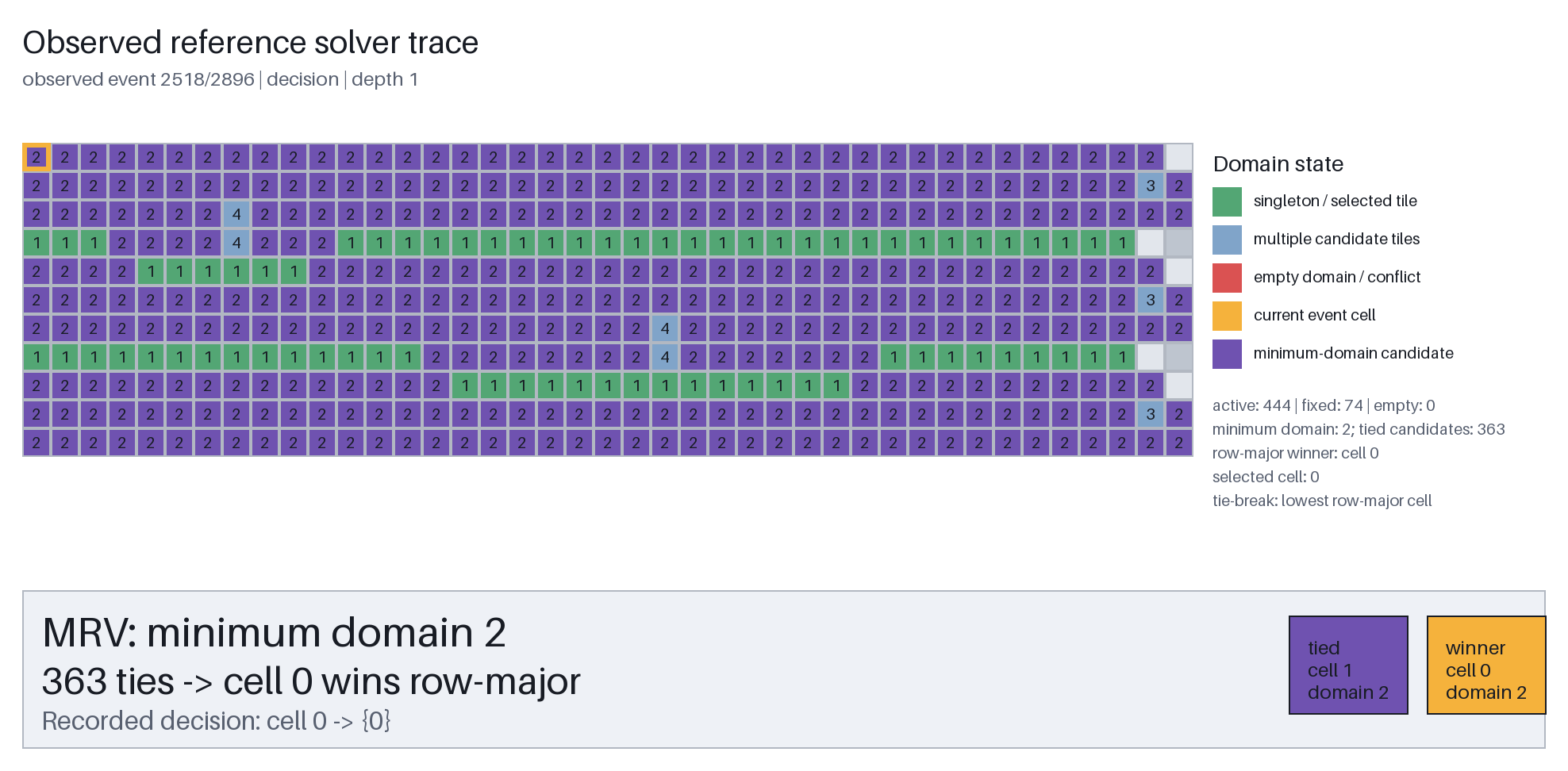
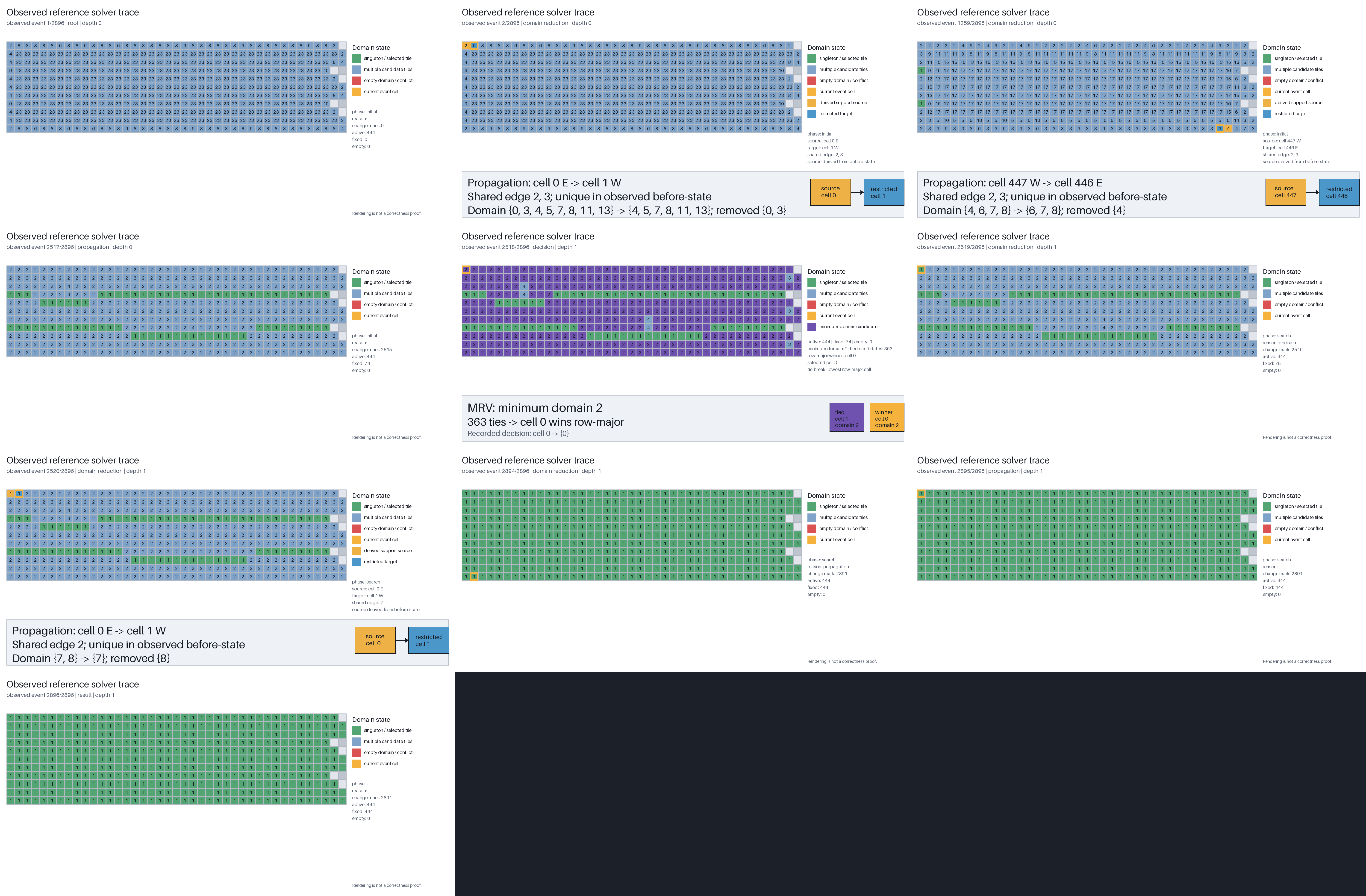
The solver applies boundary restrictions and local arc propagation, chooses the next non-singleton cell by row-major minimum remaining values, and explores choices with iterative depth-first search and an undo trail. Every SAT result is checked before publication.
See concrete propagation, MRV, conflict and rollback states →.
Primary animation
reference_trace selects semantic milestones from one complete observed trace.
Unshown visual frames do not mean skipped solver events.
wang-explain-manifest-v3.
Position in the pipeline
This solver consumes the native reduction. Its result is compared with the optimized invocation and Wang Z3, then passed to independent witness checks. The trace is downstream evidence and never feeds search.
Observed example
The pipeline_sat.cm13 reference run reaches SAT with a complete trace and a
checked tiling. A separately identified search-UNSAT run is available through
the dossier index; it is not part of
the SAT story.
Trust boundary
The solver establishes only its returned decision under its inputs. A trace is diagnostic, not an UNSAT certificate. The independent verifier, not the trace renderer, accepts a SAT tiling.
Artifacts and references
See the serial solver reference, trace contract, and reference profile.