Worked SAT example
The input pipeline_sat.cm13 has three variables and three clauses. All four
engines report SAT, and the returned witnesses pass their independent checks.
This page follows that one run from formula to square tiling and hex view.
The named-case command
reproduces the same input through the pipeline.
Technical provenance
Source: tests/instances/pipeline_sat.cm13. SHA-256:
3caaa6b29ac988fb4f51cc7071202d83ea1591ba6170e683b6da449cb3641542.
No initial-domain override is applied. The separate search-UNSAT example is
not spliced into this run.
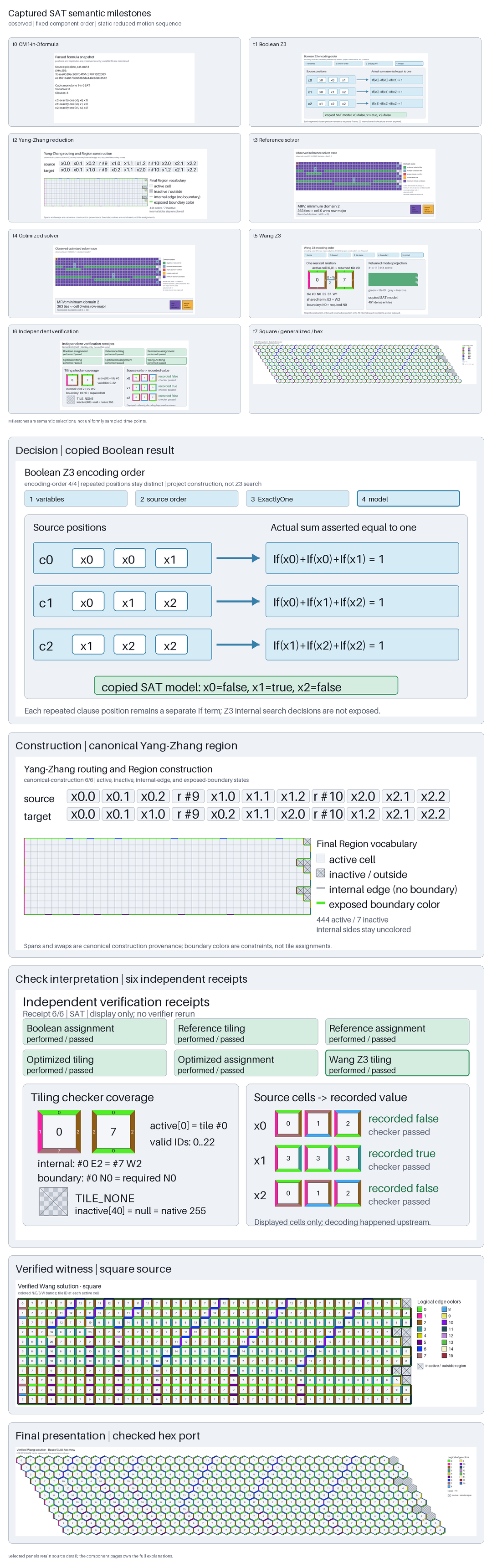
wang-run-dossier-v2#named-components.
Open the complete worked figure at full size.
The opening grid is the component map. The enlarged panels retain the captured decision, construction, checker interpretation, square witness, and final hex view at a useful reading size; the component pages own their full explanations.
Source formula
Each clause requires exactly one true occurrence. The clauses are
(x1,x1,x2), (x1,x2,x3), and (x2,x3,x3). The assignment
x1 = 0, x2 = 1, x3 = 0 satisfies all three: each contains one true x2.
The repeated occurrences count separately.
The parser’s snapshot below preserves the source clause order and is bound to the original file’s bytes. It is not reconstructed from a later tiling.
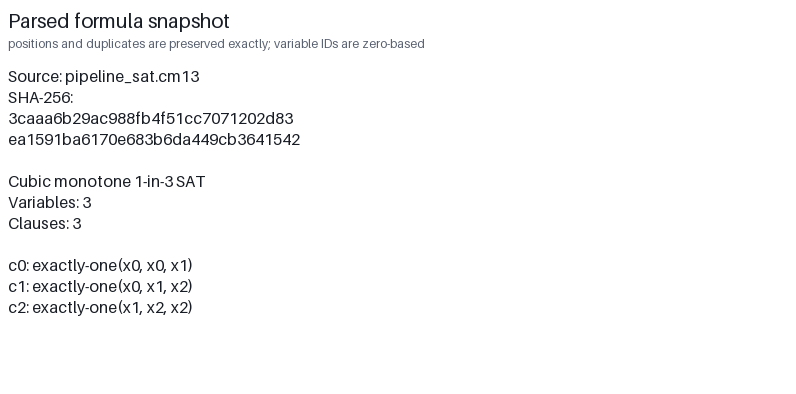
cm13-formula-snapshot-v1.
Decisions and construction
The enlarged decision panel shows the copied Boolean model; the construction panel shows the source-to-target signal order and final region vocabulary. The native builder constructs one region, one fixed tileset snapshot, and explicit construction provenance. Reference, optimized, and Wang Z3 solves then report SAT over those shared identities. Agreement means equal terminal status and independently valid witnesses; different valid witnesses need not be byte-identical.
Verification and presentation
The enlarged receipt panel distinguishes the six named checks and the copied native extraction. Only after those checks does the presentation layer render the enlarged square witness, recognize exact generalized contours, and apply the checked square-to-hex mapping shown in the final panel.
For the mechanism behind each step, read the component pages for the tileset, Boolean Z3, Yang–Zhang reduction, reference solver, optimized solver, Wang Z3, verification, and visualization.
Raw durations belong to this capture and environment. They are not a benchmark or a performance ranking. The run dossier index documents the immutable capture boundary, while the pipeline page separates the general architecture from this one observed example.