Tile vocabulary
What it is
The project uses one fixed table of 23 positional Wang tiles. Fourteen named generalized tiles describe exact rectangular groupings of those atomic IDs for explaining the Yang–Zhang construction.
Why it exists
Solvers need a small, immutable vocabulary with unambiguous edge colors and identifiers. The generalized view helps people recognize gadgets, but it does not create a second tileset or change the atomic domain seen by a solver.
Inputs and outputs
The atomic input is the compiled TILESET; its snapshot contract records IDs
and (N,E,S,W) colors. The generalized specification maps each of 14 shapes to
an exact arrangement of those 23 IDs. It outputs presentation metadata only,
with no SAT, UNSAT, or UNKNOWN status.
Mechanism
Two neighboring square tiles match when their touching edge colors are equal. Rotation and reflection are not allowed. The generalized recognizer checks the entire atomic pattern before drawing a contour, so a partial resemblance is never promoted to a generalized occurrence.
Primary animation
generalized_sheet is deliberately static: a tile vocabulary has no execution
timeline to animate. The canonical sheet is the primary reduced-motion-safe
asset, followed by its atomic legend.
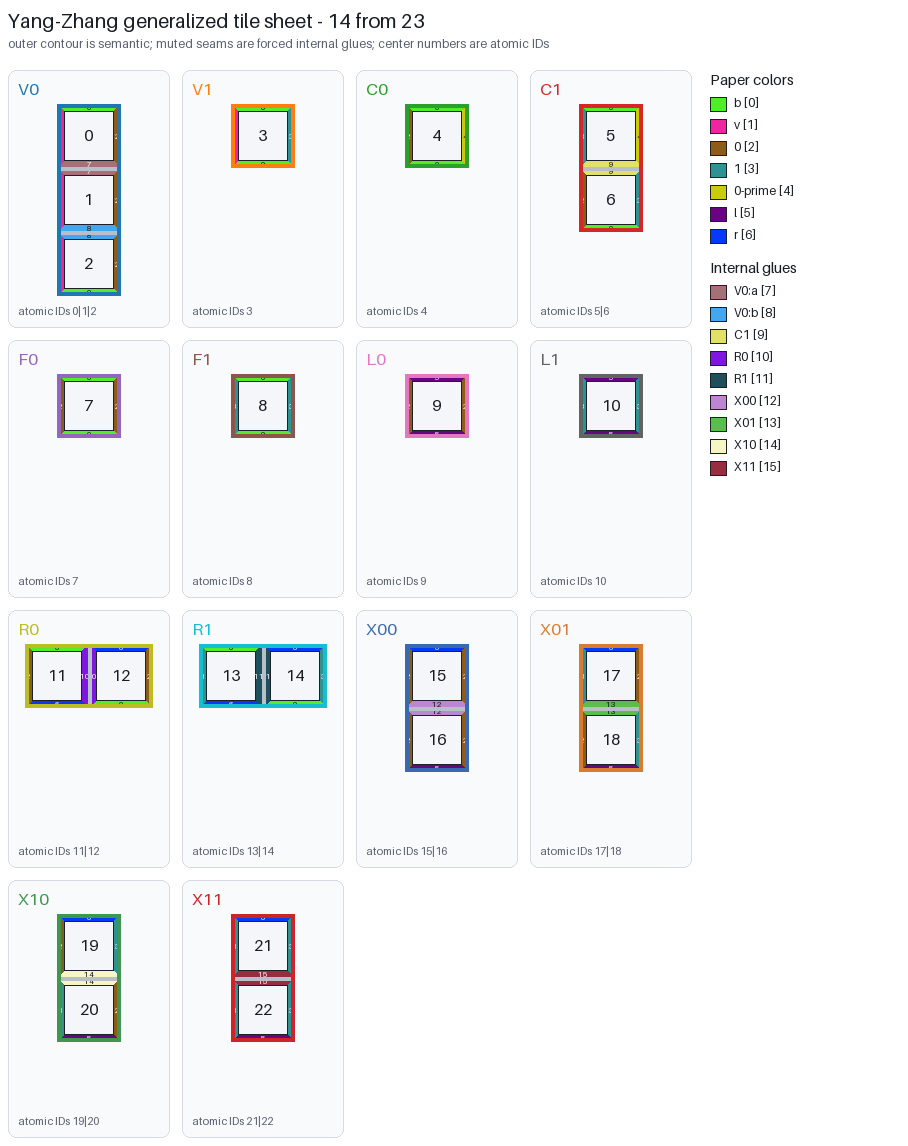
wang-generalized-tiles-v1+wang-tileset-snapshot-v1.
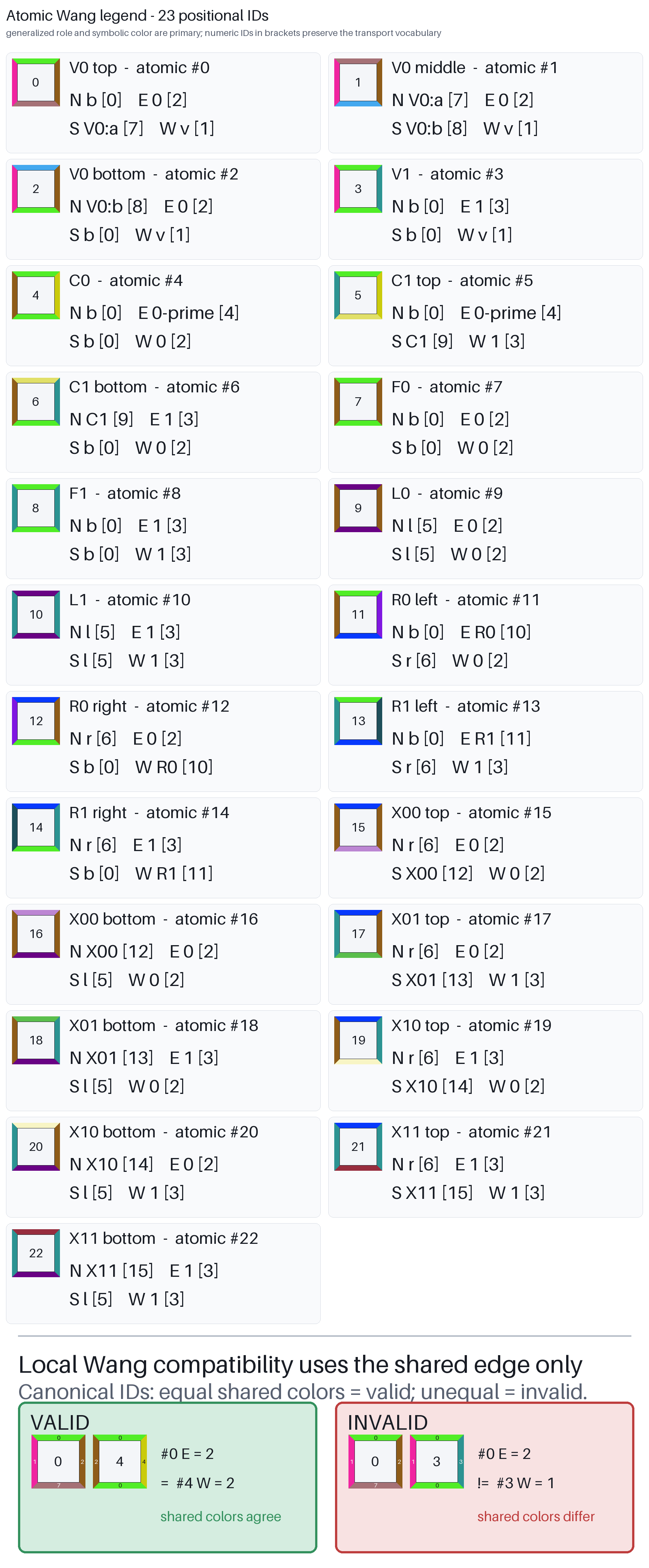
wang-generalized-tiles-v1+wang-tileset-snapshot-v1.
Position in the pipeline
The vocabulary is an immutable input to region construction and all three Wang decision paths. Generalized labels flow only to explanation and visualization; they are not semantic solver input.
Observed example
The named pipeline_sat.cm13 capture binds the same tileset identity into the
region, both native trace manifests, Wang Z3 summary, solution, and rendered
views. The displayed sheet is canonical construction data, not an observed
solver trace.
Trust boundary
The tile table and matching rule define local compatibility. They do not prove that a region is tileable, that a reduction is correct, or that a rendered witness is valid. Those claims belong to construction tests, solvers, and the independent verifier.
Artifacts and references
See the static snapshot contract,
the reduction note, and the
Yang–Zhang builder contract.
The public C table is defined in include/wang/tile.h and src/core/tile.c.