Yang–Zhang construction
What it is
The native Yang–Zhang builder transforms a validated Cubic Monotone 1-in-3 SAT formula into one finite simply connected region over the fixed 23 Wang tiles.
Why it exists
This component owns the semantic bridge from Boolean clauses to boundary-colored
geometry. Solvers remain generic consumers of a Region; they do not know
about variables, clauses, gadgets, or the reduction theorem.
Inputs and outputs
Input is a canonical formula. Output is a caller-owned reduction containing the region, adjacent-swap trace, and optional immutable provenance. Snapshot and explanation contracts bind formula, tileset, region, signal, permutation, and gadget-span identities.
Mechanism
Variable signals are routed in source order through forwarders and adjacent crossovers into clause gadgets. The implementation decomposes generalized tiles into the fixed atomic IDs and constructs the complete exposed boundary transactionally.
Primary animation
region_construction is a deterministic construction view, not an instrumented
clock or solver trace.

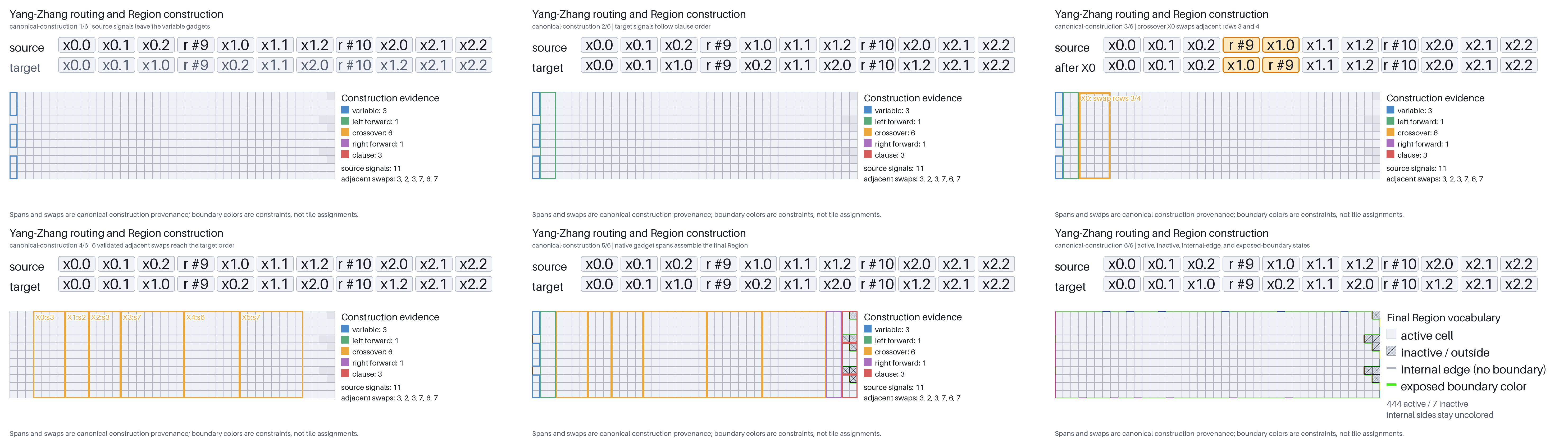
wang-reduction-explanation-v1.
Position in the pipeline
The builder follows parsing and supplies the shared region to the reference solver, optimized solver, and Wang Z3 oracle. Boolean Z3 remains a parallel source-level cross-check; rendering is a removable downstream consumer.
Observed example
For pipeline_sat.cm13, the capture builds the reduction once and shares its
hash-bound formula, tileset, region, and provenance across both native runs and
the Wang oracle.
Trust boundary
Provenance explains what the native builder constructed. It is not a second reduction and does not by itself prove satisfiability. Black-box reduction tests, Boolean agreement, witness correspondence, and independent tiling verification establish separate obligations.
Artifacts and references
Read the reduction note,
builder contract, and
provenance contract.
Public ownership begins in include/wang/yang_zhang.h.