Verified visualization
What it is
Visualization is the removable downstream layer that renders a verified square Wang witness, recognizes exact generalized shapes, and produces a checked pointy-top hex presentation.
Why it exists
Dense solution arrays are precise but difficult to inspect. These views expose tile IDs, boundaries, generalized gadget structure, and the square-to-hex correspondence without moving correctness into pixels.
Inputs and outputs
Input is a validated wang-solution-v1 square witness and the canonical
generalized specification. Outputs are raster presentations only. The hex view
has a raster-independent inverse check and remains a one-to-one transformation
of the square witness, never a separate solution schema.
Mechanism
The square renderer draws the stored active cells and edges. Generalized
recognition accepts only exact atomic patterns. The hex port maps (x,y) to
pointy-top axial (q,r), preserves the four source edges, and assigns one fresh
color to the two additional axes.
Primary animation
witness_presentation moves from the verified square witness through exact
generalized recognition to the checked hex port.

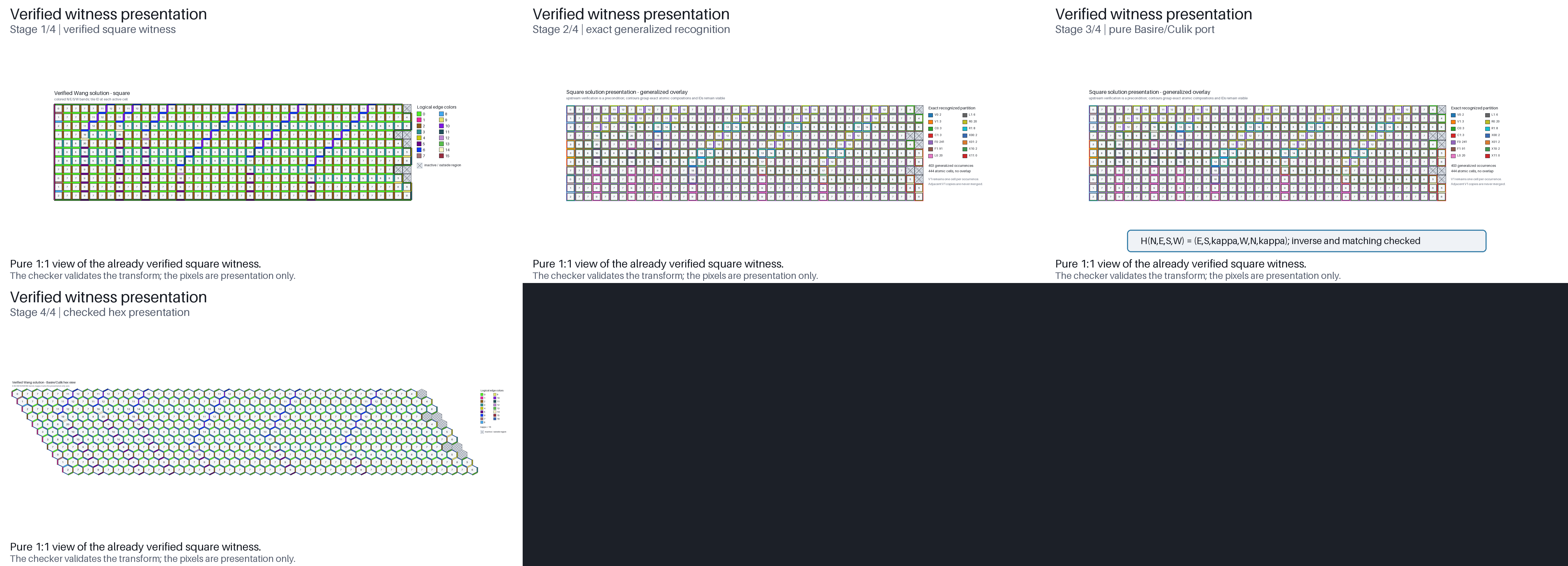
wang-solution-v1+wang-generalized-tiles-v1+checked-square-to-hex.
Position in the pipeline
Presentation follows independent SAT verification. No rendered output is fed back to a solver, oracle, reduction, or checker. Removing this layer leaves all semantic decisions and witness validation intact.
Observed example
All three views below derive from the same checked pipeline_sat.cm13 square
witness.
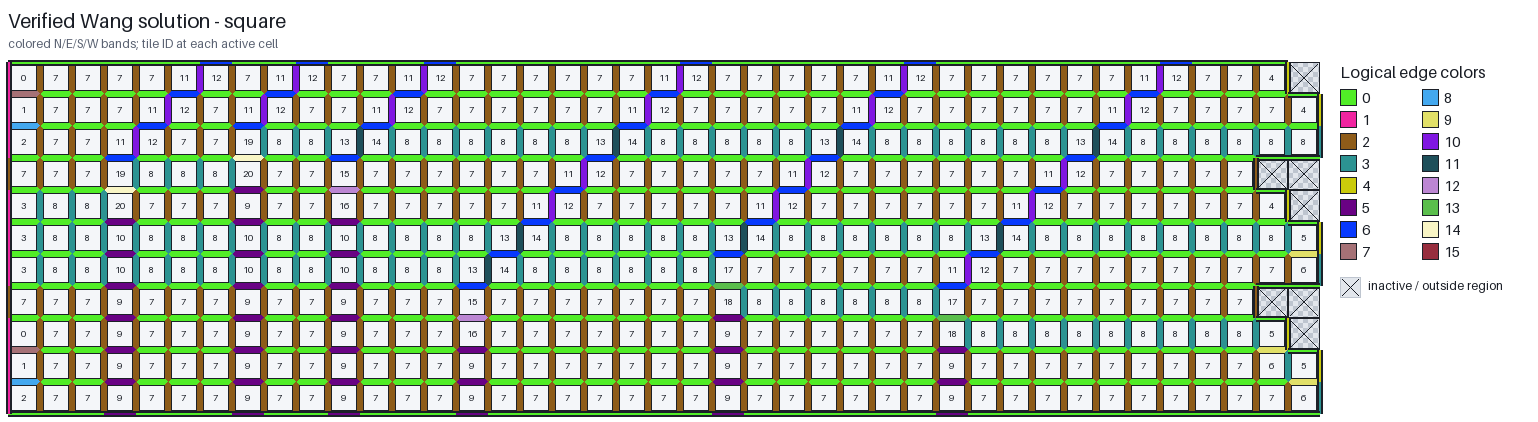
wang-solution-v1.
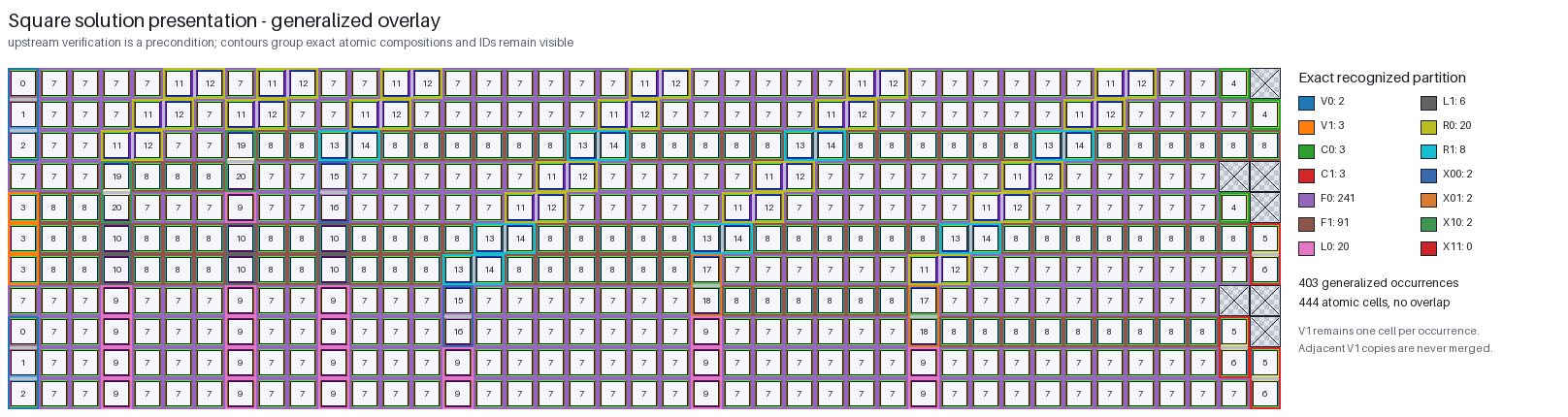
wang-solution-v1+wang-generalized-tiles-v1.

wang-solution-v1+checked-square-to-hex.
Trust boundary
The square witness contract and independent tiling verifier establish SAT witness validity. The generalized recognizer and square-to-hex checker establish their transformation relationships. None of the PNG or GIF files is itself a proof or an independent solver result.
Artifacts and references
See the snapshot views, square solution contract, and square-to-hex reference.